Freezer Is Cold but Fridge Is Warm: Checks, Causes and Repairs
Protect your food, check vents, doors and frost, and defrost safely. Then follow the cold-air path to the fan, damper, sensor or board, with what each repair costs.
By Alice Truong
Updated 10-minute read
Contents
- Short answer
- Is your food safe?
- How cold air reaches the fridge
- Five-minute checks, no tools
- Clear frost with a manual defrost
- Causes, most likely first
- 1. Frost the automatic defrost isn't clearing
- 2. Evaporator fan
- 3. Damper stuck closed
- 4. Temperature sensor
- 5. Control board
- What the repair costs
- Repair or replace
- When to call a technician
Short answer
When the freezer stays cold but the fridge warms up, the freezer’s cold air is usually not reaching the fridge. The usual blocks are packed vents, frost on the freezer’s cooling coil, a stopped fan or a stuck damper.
Check the food temperature first, then run the five-minute checks. If you find frost or hear a fan hitting ice, a manual defrost often brings the cooling back for a while; a repair then fixes the cause. A new fan or defrost heater costs about $120–$400 installed, and a control board $400–$1,000 (cost guides from 2025 and 2026).
If the freezer is warm too, or the lights work but nothing cools, read fridge not cold enough instead. A store demo mode, for example, keeps the lights on with the cooling off.
Contents
- Short answer
- Is your food safe?
- How cold air reaches the fridge
- Five-minute checks, no tools
- Clear frost with a manual defrost
- Causes, most likely first
- 1. Frost the automatic defrost isn't clearing
- 2. Evaporator fan
- 3. Damper stuck closed
- 4. Temperature sensor
- 5. Control board
- What the repair costs
- Repair or replace
- When to call a technician
Repair at a glance
- Difficulty
- Moderate
- Time
- 5 minutes to check; 8–24 hours to defrost
Is your food safe?
Put an appliance thermometer in the fridge and another in the freezer. Food is safe in a fridge at 40 °F or below and a freezer at 0 °F or below. When you’re unsure about one item, check it with a food thermometer.
A closed fridge keeps food cold for about four hours without cooling. A closed freezer holds for about 48 hours when full, 24 when half full. Count from when the fridge started to warm, not from when you noticed.
- Throw out meat, poultry, fish, eggs and leftovers once they’ve spent two hours above 40 °F.
- Never taste food to judge it. Use USDA’s food-safety guide and its chart, item by item.
- Move what’s still safe to another fridge, or to a cooler with ice or frozen gel packs, until the fridge is fixed.
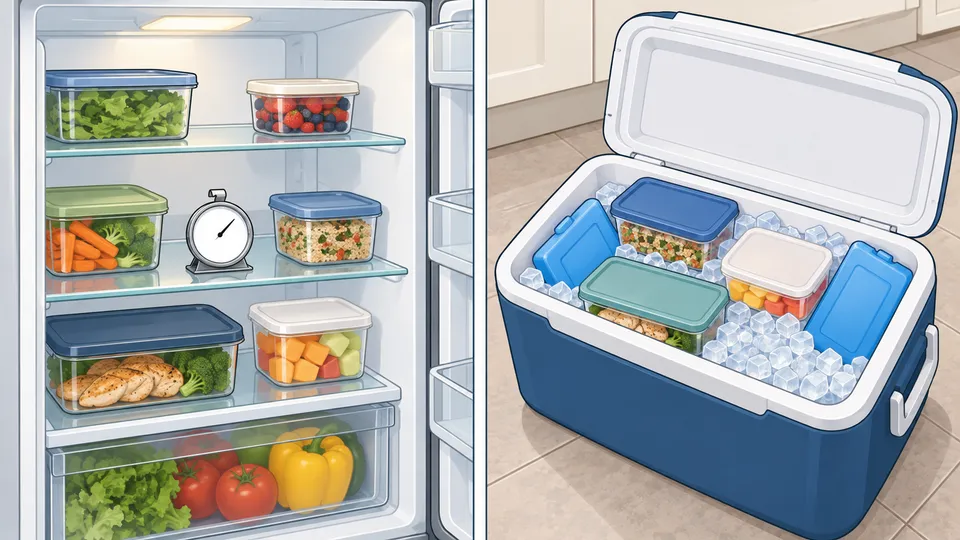
Illustration (AI-generated): Best Fridge Review. Checking fridge temperature and keeping food cold elsewhere.
How cold air reaches the fridge
A conventional fridge has one cooling coil, the evaporator, behind the freezer’s back wall. A fan blows its cold air through vents, and a damper lets some of it into the fridge. Anything that blocks that path leaves the fridge warm while the freezer stays cold.
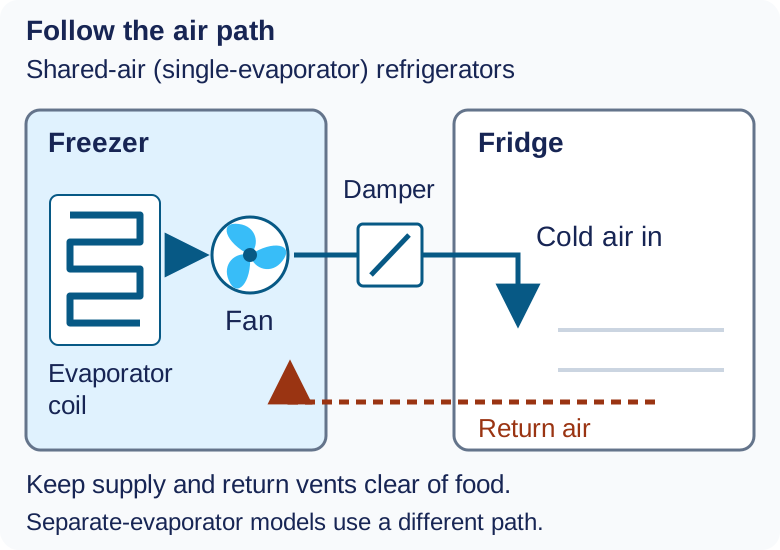
Diagram: Best Fridge Review.
Some fridges cool each side with its own evaporator: GE’s ClimateKeeper dual-evaporator models and Samsung’s Twin Cooling Plus models, for example. Their fridge never gets freezer air, so the damper and freezer-fan causes below don’t apply. Your manual or spec sheet names the system.
Five-minute checks, no tools
The setting. Set the controls to the middle or the manual’s recommended setting, including any airflow control on the freezer’s back wall. Wait 24 hours before changing them again, and keep food cold elsewhere meanwhile.
The vents. Leave about 2 inches in front of the vents in both compartments. Cold air comes into the fridge through a vent from the freezer. Hold a hand at that vent as soon as you open the fridge: little or no cold air points to the air path. Frost on a vent blocks air even after food is moved; clear it with a manual defrost.
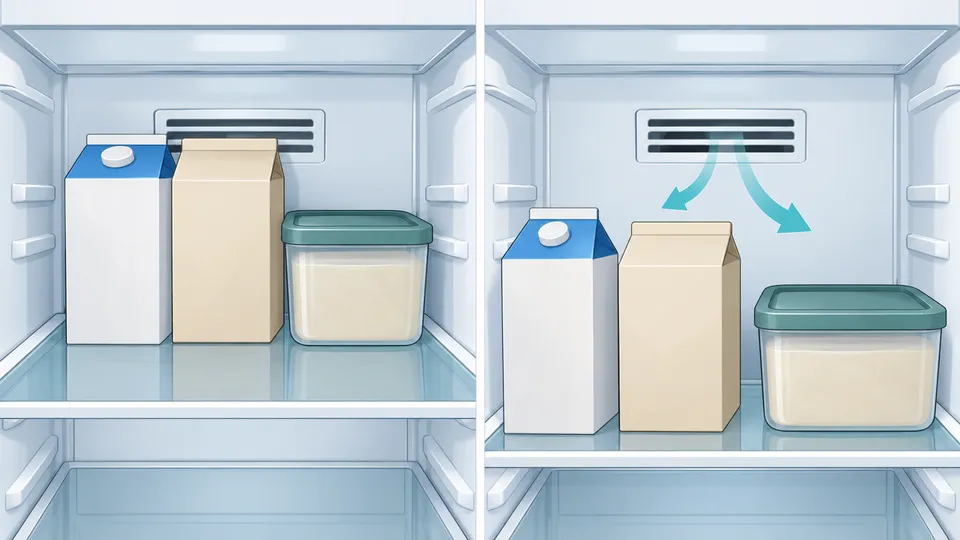
Illustration (AI-generated): Best Fridge Review. Blocked vent (left), clear vent (right).
The door seals. Close each door on a sheet of paper and pull it out. A slight drag means the seal works there; if it slides out, clean the seal and try again. Frost or condensation along a door edge marks a spot that isn’t sealing.
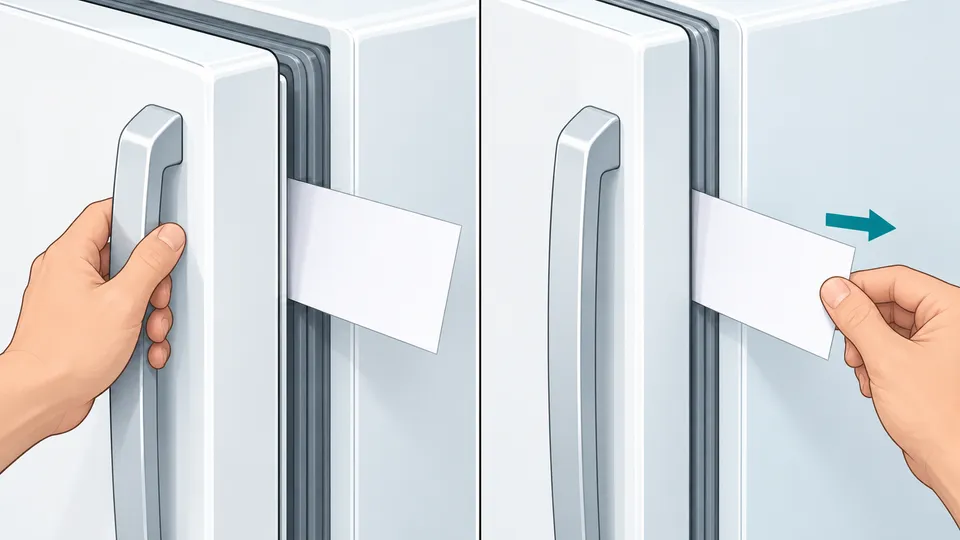
Illustration (AI-generated): Best Fridge Review. Closing the door on paper, then pulling it out.
The doors close. Look for a package or drawer holding a door ajar. Even a small gap lets in moist air, which turns to frost.
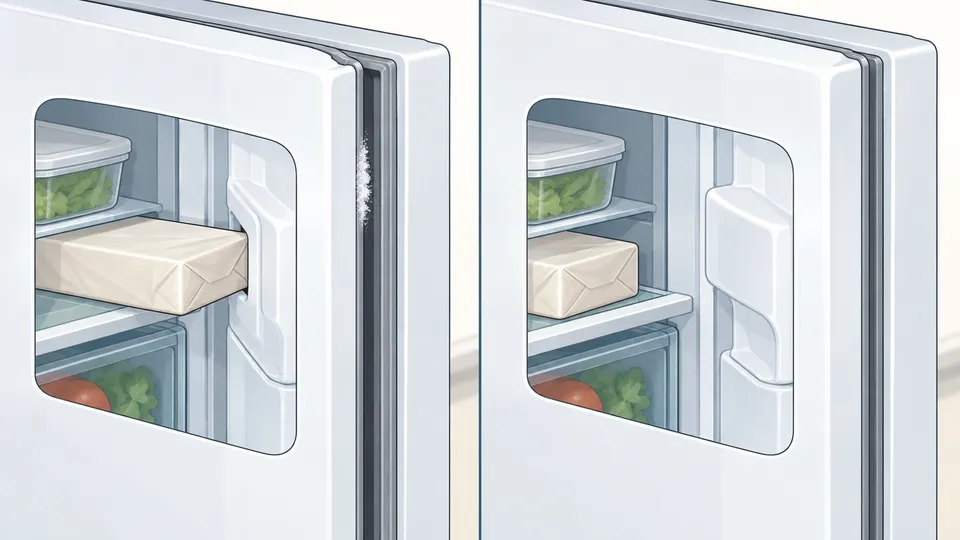
Illustration (AI-generated): Best Fridge Review. A protruding package leaving a gap beside the gasket.
The fan. With the doors shut, listen at the freezer. A silent fan may be pausing for a defrost (on GE models, usually 25–45 minutes), so listen again later. A fan that ticks or scrapes, and stops when you open the door, is hitting ice.
Error codes. If the display already shows a code, photograph it and look it up in the maker’s error-code guide before you unplug anything: Samsung warns that unplugging or clearing a code makes diagnosis harder. If no code shows, Samsung suggests switching the fridge off at the plug or breaker for 2 minutes; a code that appears afterwards may mean it needs service.
The condenser. If the coils can be reached from outside (under the front grille, on the back or on top), unplug the fridge before brushing dust off them. Some coils can’t be reached by owners, and most GE models made since 2001 have coils that never need cleaning.
Clear frost with a manual defrost
Frost on the vents or the freezer’s back wall, or a fan hitting ice, calls for a manual defrost. It clears the ice safely:
- Move the food to another fridge or a cooler with ice or gel packs, and empty the ice bin.
- Unplug the fridge and prop both doors open.
- Lay towels inside and under the fridge, and swap them as they get wet.
- Wait. LG says at least 8 hours; Samsung says until the towels stay dry, or at least 24 hours.
- Don’t use a hair dryer or any other heat source to speed it up: it can damage the fridge.
- Dry the inside, plug the fridge back in and close the doors. Samsung allows about 2 hours before food goes back; LG says normal running can take 24–48 hours. Check the thermometer before you return perishables.
If the frost or the noise comes back, the defrost hasn’t fixed the cause: book a repair. Our fridge not defrosting guide covers the defrost parts.
Where the frost sits is a clue:
| Where you see frost or ice | What it points to |
|---|---|
| Along a door edge or the gasket | A door that isn’t sealing or closing fully |
| A sheet of ice on the freezer floor | A blocked drain line; if it re-forms after a defrost, it needs a repair visit |
| The freezer’s back wall and vents | Vents blocked by packed food, a freezer set colder than its normal setting, or a defrost that isn’t clearing the coil |
Causes, most likely first
Follow the air from the coil to the fridge, then the controls. Each part below is replaced by a repairer; costs are in the next section.
1. Frost the automatic defrost isn’t clearing
You’ll notice: frost on the freezer’s back wall or vents, a fan hitting ice, or cooling that comes back after a manual defrost and fades again. On LG models, an FF code can mean frost has stopped the freezer fan.
The fix: a frost-free fridge regularly runs a defrost heater to melt the coil’s frost. When frost keeps coming back, a repairer checks the heater, its thermostat or sensor, and the control that starts it.
2. Evaporator fan
You’ll notice: no fan sound and no air at the vents, long after a defrost pause would have ended, with no frost to explain it. LG’s FF code points here too.
The fix: a new fan motor matched to the model, once ice is ruled out.
3. Damper stuck closed
You’ll notice: the freezer fan runs and the freezer is cold, but little or no air reaches the fridge vent, and there’s no frost. Only fridges that share freezer air have a damper.
The fix: a new damper assembly, or its wiring or control, once checked. Don’t force the flap.
4. Temperature sensor
You’ll notice: a sensor error code on the display. LG, for example, lists separate fridge, freezer and defrost sensor errors.
The fix: a new sensor, or its wiring.
5. Control board
You’ll notice: nothing specific. The board is the last suspect, after the parts and wiring above have been ruled out.
The fix: a board matched to the model, approved only after that diagnosis.
What the repair costs
A repair visit costs $70–$130 at minimum (HomeGuide), which usually covers up to an hour of labor and the diagnosis. Installed prices below include the part and labor. The part prices are single listings, checked October 19, 2026; follow a part number to check it fits your model.
| Repair | Installed, from cost guides | The part alone: example listings |
|---|---|---|
| Defrost heater | $120–$400 (HomeGuide) | GE WR51X10055: $78.16 at GE, $91.99 at Allstar |
| Evaporator fan motor | $120–$200 (Fixr); $250–$400 (HomeGuide) | GE WR60X31522: $77.26 at GE. Whirlpool WPW10189703: $45.99 at Allstar. Frigidaire 5303918549: $46.99 at Allstar |
| Damper | Neither guide gives a figure; ask for a quote | GE WR49X10091: $189.99 at Allstar, $220.90 at GE |
| Temperature sensor | Neither guide gives a figure; ask for a quote | GE WR55X10025: $13.99 at Appliance Parts Company, $15.98 at GE |
| Control board | $400–$750 (HomeGuide); $500–$1,000 (Fixr) | GE WR55X10942: $354.68 at GE |
The fan numbers from the 2014 version of this page have moved on: GE WR60X10141 is now WR60X31522, and Whirlpool W10189703 is now WPW10189703.
A part fits only the models it’s listed for, so copy the full model number from the label inside the fridge. Frigidaire puts it high on the left wall in top-freezer fridges, and high on the right in French-door and side-by-side fridges.
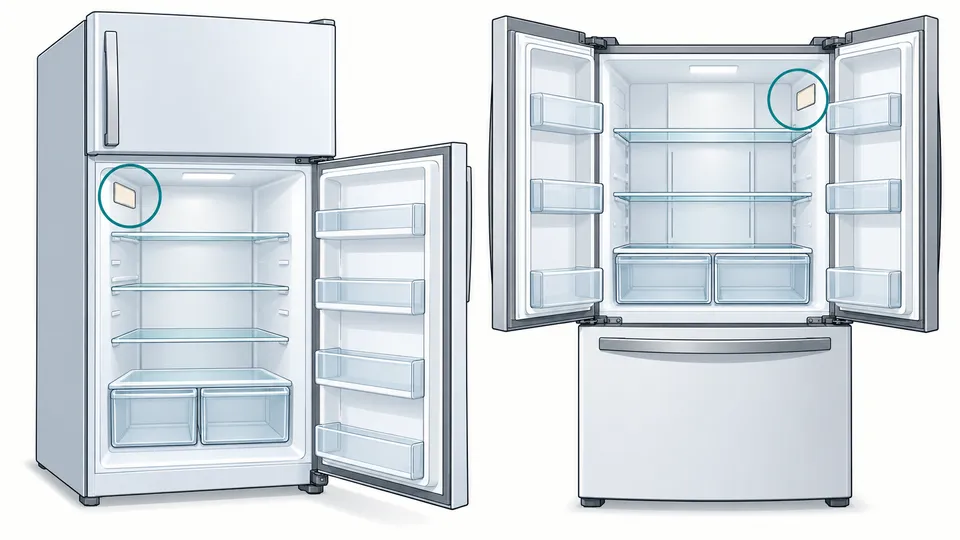
Illustration (AI-generated): Best Fridge Review. Label locations described by Frigidaire for these two fridge types.
Repair or replace
HomeGuide’s rule of thumb: repair a fridge that is under 10 years old, still has warranty cover, and whose repair costs less than half the price of a new one. A replacement costs $675–$2,500 in its 2026 guide.
Your purchase record or the maker’s support line can confirm the age and warranty. To compare running costs, use each model’s yearly energy figure at the same electricity price.
When to call a technician
Book a repair for anything behind a panel: the fan, damper, sensors, defrost parts, wiring or board. Frigidaire’s service sheet is for qualified repairers only, because of the risk of electric shock, and has them disconnect the power cord before servicing.
The sealed system (the compressor, coils and refrigerant) needs a certified technician. Under EPA Section 608, attaching gauges and adding or removing refrigerant count as covered work.
Tell the repairer your full model number, both thermometer readings, where any frost is, any error code, and what you’ve already tried.
Service notes for repairers, by model
- GE PSC21MGM, PSC23MGM, PSI21MGM and PSI23MGM: service guide 31-9072 enters self-diagnostic mode with all four temperature buttons held for about 3 seconds; test 0 7 checks the sensors and 1 6 exits. Its sensor resistance table is in the guide.
- Frigidaire, service sheet A06589001: separate tests for the evaporator fan, the damper (airflow when open) and each sensor, and a step to tell a part fault from a board or wiring fault.
- LG LFC25765 (manual MFL67306601): “OFF” on the display means demonstration mode, which disables cooling. With the fridge doors open, hold ICE PLUS and REFRIGERATOR for 5 seconds to leave it.
Sources
Checked October 19, 2026.
USDA/FSIS
EPA
GE
- Temperature controls
- Dual-evaporator systems
- Condenser coils
- Automatic defrost
- Service guide 31-9072
- Defrost heater WR51X10055
- Evaporator fan motor WR60X31522
- Damper control kit WR49X10091
- Temperature sensor WR55X10025
- Main control board WR55X10942
Whirlpool
Samsung
LG
Frigidaire
Allstar
- Defrost heater WR51X10055
- Damper control kit WR49X10091
- Evaporator fan motor WPW10189703
- Evaporator fan motor 5303918549