Fridge Not Cold Enough? Checks, Causes and Repair Costs
Freezer still at 0°F? Cold air isn't reaching the fridge. Both too warm? Check settings, seals and coils, then the condenser fan, start relay, compressor, refrigerant and control board.
By Alice Truong
Updated 12-minute read
Contents
- Short answer
- Is your food safe?
- Measure the fridge and freezer separately
- Choose your next step
- Quick checks when both are warm
- Power and cooling mode
- Settings
- Door seals
- Level
- Room and clearance
- Clean the condenser coils if you can reach them
- Causes when both compartments are warm
- 1. Dirty condenser coils
- 2. Condenser fan
- 3. Start relay or compressor
- 4. Refrigerant leak
- 5. Control board or thermostat
- Repair or replace
- When to call a technician
Short answer
Measure the fridge and the freezer before you choose a repair. If only the fridge is warm and the freezer holds 0°F, cold air isn’t reaching the fridge: follow our freezer cold but fridge warm guide. If both are warm, start with the quick checks below. Then look and listen: frost over the freezer’s back wall, or a freezer fan that stays silent while the compressor runs, points to the freezer’s coil, fan or defrost. Without those signs, including when the compressor and fans are all silent, work through the five causes below that warm both compartments at once.
Move perishable food out now to a working fridge or a cooler with ice, and keep the doors shut while you diagnose.
Contents
- Short answer
- Is your food safe?
- Measure the fridge and freezer separately
- Choose your next step
- Quick checks when both are warm
- Power and cooling mode
- Settings
- Door seals
- Level
- Room and clearance
- Clean the condenser coils if you can reach them
- Causes when both compartments are warm
- 1. Dirty condenser coils
- 2. Condenser fan
- 3. Start relay or compressor
- 4. Refrigerant leak
- 5. Control board or thermostat
- Repair or replace
- When to call a technician
Repair at a glance
- Difficulty
- Easy
- Time
- About an hour, then up to a day to confirm
- Do it yourself
- About $10 for a coil brush
- Technician
- $70–$130 call-out, plus the repair
Is your food safe?
Food is safe while the fridge reads 40°F (4°C) or below and the freezer 0°F (-18°C) or below.
- How long you have: with its door kept shut, a fridge that has stopped cooling keeps food cold for about 4 hours. A full freezer lasts about 48 hours, and a half-full one about 24.
- What to throw out: meat, poultry, fish, eggs, leftovers and other perishables that have spent 2 hours or more above 40°F. Don’t taste anything to decide.
- Frozen food: anything that still has ice crystals, or is at 40°F or below, can go back into a working freezer.
- When you don’t know how long it was warm, throw it out.
For a food-by-food list, use the USDA food-safety guidance.
Measure the fridge and freezer separately
A dial or display shows a setting, not the temperature inside: GE’s numbered controls, for example, don’t match an exact temperature. Use two appliance thermometers.
- Fridge: stand the thermometer in a glass of water, as near the middle of the compartment as you can.
- Freezer: tuck it between frozen packages instead. A glass of water can freeze and shatter there.
- Wait before you read them. With the doors shut, a reading can take up to 8 hours to settle. Write down both readings and the time.
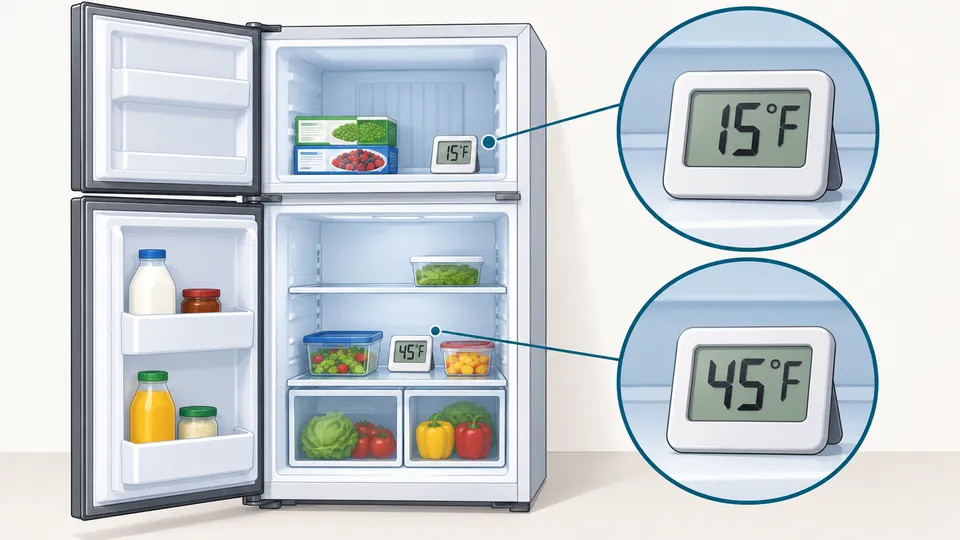
Illustration (AI-generated): Best Fridge Review. Example readings: 15°F in the freezer and 45°F in the fridge. Both are too warm, so run the quick checks first, then use the table below to decide where to look next.
Choose your next step
| What you find | Next step |
|---|---|
| Fridge above 40°F; freezer at 0°F or below | Cold air isn’t reaching the fridge. Use the freezer cold but fridge warm guide. |
| Both too warm, and frost covers the freezer’s back wall or vents, or the freezer fan stays silent while the compressor runs | Cold isn’t being moved off the freezer’s coil. The usual causes are a frosted evaporator coil, a failed evaporator fan or a defrost fault. Use the freezer cold but fridge warm guide and why your fridge is not defrosting. |
| Both too warm, without those signs: the compressor cycles, runs nonstop, clicks on and off, or is silent along with the fans | Continue below: the quick checks, then the causes that warm both compartments. |
| Both on target now | Keep reading the thermometers for a day or two if cooling has been patchy. Today’s reading doesn’t tell you how warm the food got earlier. |
A silence of less than 45 minutes can be normal. During automatic defrost, neither the compressor nor the fans run, so listen again an hour later. Frost, or a silent freezer fan while the compressor runs, points to the freezer side. A compressor that runs nonstop doesn’t on its own, because dirty coils and a refrigerant leak cause that too. A compressor and fans that stay silent together point to power or the control board, which also runs the fans.
Quick checks when both are warm
These need no tools beyond a level, a coil brush and a thermometer.
Power and cooling mode
If the light and display are dead too, check the circuit breaker first. A lit interior doesn’t prove the fridge is cooling, though. Look for a cooling-off, demo or showroom mode, especially after a new installation or a power cut. Some Whirlpool fridges have to be switched back on after an outage or surge.
On Samsung models, OF OF, O FF or OFF OFF on the display means Cooling Off mode is on.
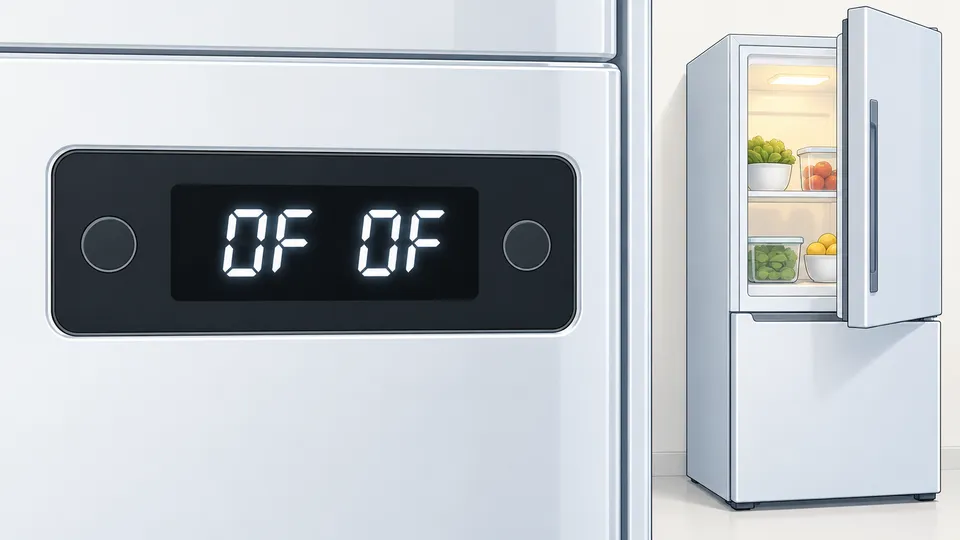
Illustration (AI-generated): Best Fridge Review. The OF OF indication Samsung describes: the light works while cooling is switched off.
Settings
Set the fridge to 37°F and the freezer to 0°F. On a numbered dial, start from the middle setting. After any change, wait 24 hours before you judge it. Samsung allows up to 28 hours for a fridge to reach a new setting with the doors closed.
A big shop after a holiday warms both compartments for a while. So do doors opened often or left open. GE suggests turning the controls colder while the fridge is heavily loaded. Don’t leave food in a warm fridge while you wait for it to recover.
Keep packages off the air vents inside both compartments, so the cold air can move.
Door seals
Shut each door on a sheet of paper or a dollar bill, then slide it out. If you feel a slight drag, the seal is gripping at that spot. Try the top, sides and bottom of every door. If the paper slips out freely, wash the gasket with a damp cloth and dish soap and test again. If it still slips out, book a service visit for the seal.
Level
A fridge that leans can stop a door from closing tight, and the paper test then fails even with a good seal. Set a spirit level on the floor under the fridge. If the floor is uneven, adjust the levelling legs or add shims.
Room and clearance
A fridge sheds heat to cool. Squeezed into a tight cabinet opening, it can’t get rid of that heat. Typical gaps are ½ inch at the sides and 1 inch behind. Samsung asks for 2 inches at the back, top and sides. Keep the fridge out of direct sun and away from an oven, stove or radiator.
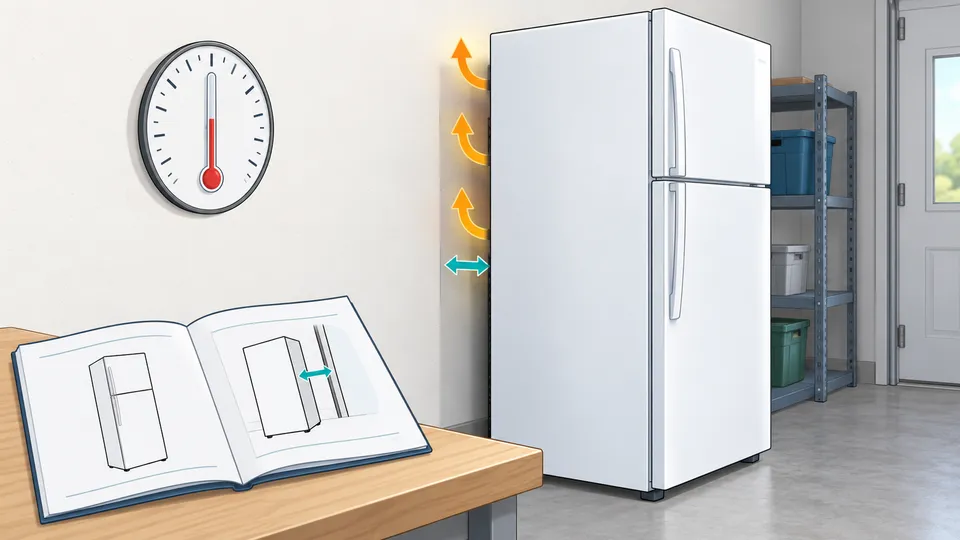
Illustration (AI-generated): Best Fridge Review. Check the room temperature and the gap behind the fridge. The scale and gap shown are not a rating for your fridge.
Room temperature matters too, especially in a garage. The Whirlpool top-freezer fridges in its guide are made for rooms between 55°F and 110°F (13–43°C). Outside that range, they may not hold their temperatures.
Clean the condenser coils if you can reach them
Dust and pet hair on the condenser coils trap heat, so the fridge runs but never gets cold enough. The coils sit behind the base grille at the bottom front, on the back, or on top. Most GE fridges made since 2001 have a NeverClean condenser, which needs no cleaning.
- Unplug the fridge. For coils on top, switch off its circuit breaker instead.
- Coils at the bottom: take off the base grille and brush the coils with a long condenser brush. Then vacuum the dust off the floor. Coils on the back: pull the fridge out and brush them. Coils on top: wear long sleeves and gloves, because the fins are sharp.
- Refit the grille and push the fridge back. Don’t roll it over the power cord or the water line. Then plug it back in, or switch the breaker back on.
In a dusty or greasy room, or with pets, clean them every two to three months. A coil brush costs about $10.
If both readings are still high 24 hours after these checks, move on to the causes below.
Causes when both compartments are warm
These faults stop the fridge making cold, so the fridge and freezer warm together. They start with the cheapest to check. Costs are US national ranges from public cost guides, checked October 19, 2026. Most quotes add a call-out fee of $70–$130, which usually covers up to an hour of labor and the diagnosis.
1. Dirty condenser coils
What you notice: both compartments drift warm, the fridge runs longer than it used to, and the coils are furred with dust or hair. Clogged coils make the compressor work harder.
Who fixes it: you, where the coils are reachable (see the steps above).
Cost: about $10 for a brush. A technician charges $70–$130 to vacuum and inspect them.
Repair or replace: clean them. Dirty coils are never a reason to replace a fridge.
2. Condenser fan
The condenser fan keeps the coils and compressor cool. On most fridges it sits near the floor at the back, beside the compressor. Fridges with their coils on the back have no condenser fan.
What you notice: stand behind the fridge while the compressor whirs. The fan should run whenever the compressor does. A silent or noisy fan, and a fridge that seems to run all the time, point to a failed fan.
Who fixes it: a technician. Whirlpool and Maytag both leave condenser fan repairs to a professional.
Cost: $200–$350 to replace the fan motor.
Repair or replace: usually worth repairing. A dead fan also lets the compressor overheat, so fix it soon.
3. Start relay or compressor
The start relay gives the compressor an extra kick of current to start. Without it, the compressor can’t run.
What you notice: every few minutes there’s a click at the back, a short hum or buzz, then silence, and the fridge never gets cold. That points to a failed start relay or to the compressor itself. Other compressor warnings: it runs without stopping, gets unusually loud, or keeps tripping the breaker.
A few minutes of clicking right after a power cut is normal: GE says the compressor can take 3 to 5 minutes to restart. Fridges with an inverter compressor have no start relay, so the click-and-hum pattern means something else on those.
Who fixes it: a technician. They should rule out the relay before condemning the compressor, which costs far more. Replacing a compressor means cutting into the refrigerant line, which is sealed-system work (see Refrigerant leak below).
Cost: about $75–$300 for a relay. Fixr gives that range in its freezer guide; we found no fridge-specific figure. A compressor runs from $200–$650 (Sears Home Services, updated March 2025) to $700–$1,250 (HomeGuide). Fixr puts it at $500–$1,000.
Repair or replace: replace the relay if that’s all it is. A compressor on an older fridge can cost more than half the price of a new fridge; then, replacing the fridge is usually the better buy. Check your warranty before you decide. Maytag, for example, covers its compressors with a 10-year limited parts warranty. Warranties like that usually cover the part but not the labor.
4. Refrigerant leak
What you notice: the compressor runs nearly all the time, yet both compartments stay too warm. HomeGuide adds oily residue near the tubing as a sign.
Who fixes it: a qualified technician who works on sealed systems. On fridges that use R-134a or another non-exempt refrigerant, EPA rules say that person must hold Section 608 certification (Type I or Universal for household fridges) to attach gauges, add or remove refrigerant or cut into the lines. Household fridges that use isobutane (R-600a) are exempt from those EPA rules, but the gas is flammable, so they still need a qualified technician. Don’t pay for a refill unless the leak is found and fixed first.
Cost: $400–$1,100 to find and replace the leaking parts and recharge the refrigerant.
Repair or replace: a sealed-system repair can cost more than half a new fridge. On an older fridge, replacing it is usually the better choice.
If refrigerant is escaping: some fridges use isobutane (R-600a), which is flammable. Samsung’s manual for its R-600a models says to keep flames and sparks away, leave the fridge and its plug alone and air the room for several minutes. Open a window rather than switching on a fan.
5. Control board or thermostat
What you notice: the lights and display work, but the compressor stays silent, and often the fans too. A failed board, a wiring fault or a failed compressor can each do this.
Who fixes it: a technician. They have to work out whether the fault is in a component, the board or the wiring before replacing anything.
Cost: $200–$800 (Sears Home Services) or $400–$750 (HomeGuide) to replace the board.
Older fridges with a dial: a thermostat, not a board, decides how long the compressor runs. When it fails, temperatures run too warm, too cold or swing widely, even at the right setting. Replacing it costs $100–$400.
Repair or replace: ask for the diagnosis in writing before approving a new board, because a board replaced on a guess may not fix the fault.
Parts depend on your exact model, so a technician orders them by the full model number. Our freezer cold but fridge warm guide shows where to find that number.
Repair or replace
Get a written diagnosis and an installed quote before you decide. HomeGuide’s rule of thumb is that a repair is worth it when the fridge is under 10 years old, still under warranty, and the repair costs less than half a new one. It puts a replacement fridge at $675–$2,500.
Running costs count too. ENERGY STAR estimates that a fridge over 15 years old can cost about $95 a year more to run. Its certified fridges are about 9% more efficient than the federal minimum.
When to call a technician
Book a technician if both readings are still high a day after the quick checks. Do the same for anything behind a panel: the condenser fan, the relay, the compressor, the control board or the refrigerant.
Leave electrical work to a trained repairer. Opening the machine compartment risks an electric shock. Keep your own work to the checks above, and unplug the fridge before you clean the coils.
Leave the refrigerant to a qualified technician. For most refrigerants, EPA requires Section 608 certification to open the sealed system or add refrigerant. Household fridges using R-600a are exempt from that rule, but their gas is flammable.
Tell the repairer the full model number, both thermometer readings and when you took them, what you heard, any error code, and the checks you have already done. That helps them come with the right part.
Sources
Checked October 19, 2026.
USDA/FSIS
FDA
EPA
- Section 608 technician certification
- Regulatory updates to the Section 608 rules
- Definitions of Section 608 terms
Cornell LII
ENERGY STAR
GE
- Adjusting temperature controls
- Cleaning condenser coils
- Automatic defrost system
- Normal sounds and noises
Whirlpool
Maytag
KitchenAid
Samsung
- Cooling checks, installation space and door seals
- What temperature should I set my refrigerator to?
- Why is my refrigerator making noise?
- Compressor noise and cooling
- RF23M8070 user manual (R-600a models)